University of Liberal Arts Bangladesh with Brac University and North South University
Academics and university leaders at a national roundtable in Dhaka have called for reforms in research assessment, publication practices and university policies to promote responsible research in Bangladesh’s humanities and social sciences.
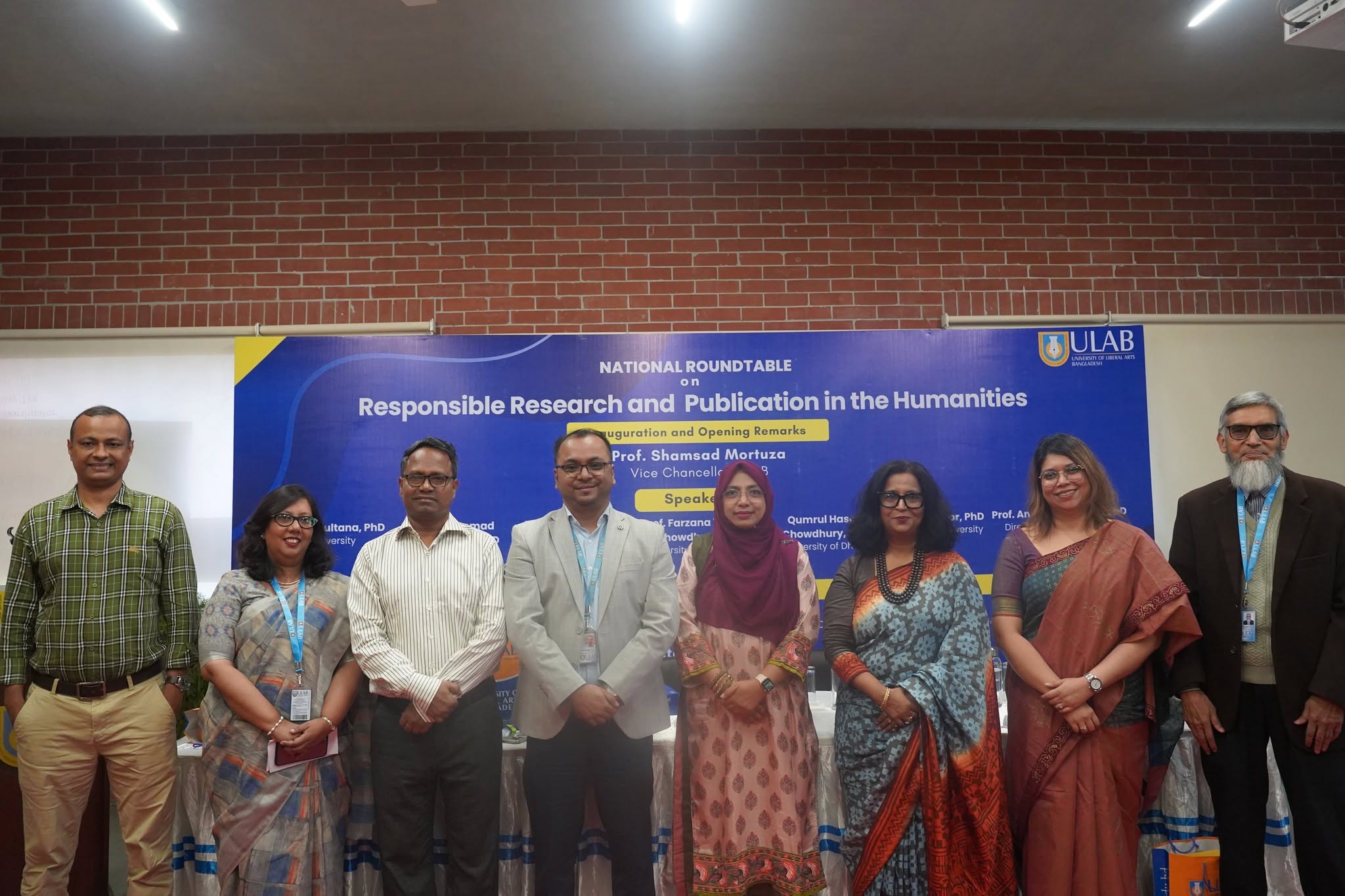
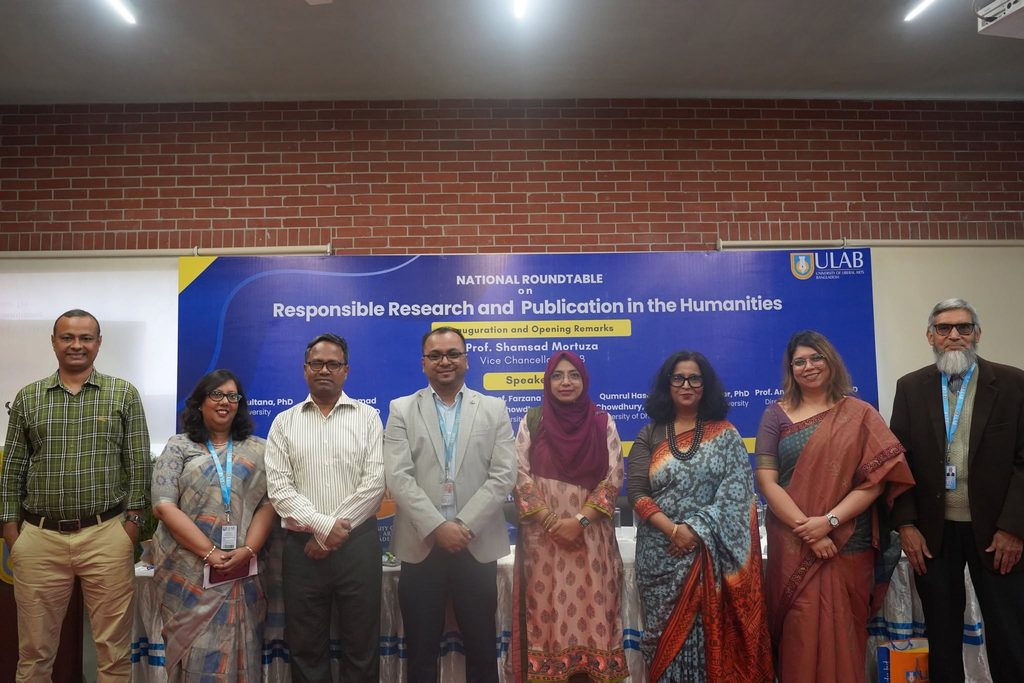
The Department of English and Humanities at the University of Liberal Arts Bangladesh (ULAB) organized the roundtable, titled “Responsible Research and Publication in the Humanities,” on its campus on 1 October. According to a press release, the event brought together scholars and academic leaders from public and private universities to discuss challenges and opportunities in academic research.
ULAB Associate Professor Dr Abu Saleh Mohammad Rafi convened and moderated the discussion, which covered research quality and purpose, publication practices, citation standards, authorship ethics, academic mentorship, generative artificial intelligence (AI), research assessment and institutional responsibilities.
Rethinking Research Beyond Publication Metrics
ULAB Vice-Chancellor Professor Shamsad Mortuza inaugurated the event with reflections on the evolving nature of research in literature and language. He observed that formal research training had historically received limited attention in humanities disciplines such as English, although scholarly publication had expanded significantly in recent years, particularly in applied linguistics.
“Our first generation scholars did not actually focus on this trend of publication…because they were more interested in expanding knowledge in humanities,” Shamsad said.
He expressed concern over the growing pressure on university departments to meet publication benchmarks imposed by institutional requirements and global university rankings. According to him, ranking systems often disadvantage arts and humanities departments because their publication output tends to be lower than that of science disciplines.
Shamsad also cautioned against unethical practices, including purchasing institutional affiliations, publishing in predatory journals and buying citations. He proposed greater interdisciplinary collaboration as a way to expand research output and share resources, particularly in response to barriers in academic publishing and knowledge distribution.
Research Should Address Real-World Problems
Participants emphasized that research should extend beyond publication targets and contribute to meaningful intellectual and social development.
Professor Shaila Sultana of Brac University argued that research should address specific problems and generate positive changes within communities, creating tangible social impact.
Professor Dr Mohammad Shafiqul Islam of Shahjalal University of Science and Technology highlighted research’s role in deepening understanding of human existence and reinterpreting established knowledge.
Meanwhile, Dr Nazia Manzoor of North South University stressed that research should challenge dominant assumptions and generate new insights into social phenomena and policymaking.
Questioning Publication and Promotion Criteria
The roundtable examined publication choices and the limited international indexing of Bangladeshi humanities and social science journals. Speakers noted the absence of Scopus-indexed journals dedicated to these disciplines in Bangladesh.
Participants questioned the heavy reliance on journal articles in university promotion systems, arguing that books, book chapters and monographs published by prestigious academic presses, including Oxford and Cambridge, may receive comparatively little recognition.
Shaila identified the tension between meeting publication requirements for career advancement and pursuing deeper, qualitative research as a major challenge for academics in Bangladesh.
Shafiqul noted that publishing in leading international journals involves rigorous and demanding review processes. He also argued that the academic publishing industry in South Asia remained significantly behind global practices.
Shaila and Nazia questioned the assumption that scholarly contributions published through blogs and newspapers should automatically be considered inferior to journal articles. They encouraged academics to critically examine international research standards, particularly the emphasis on Scopus indexing and citation-based university rankings.
Nazia also questioned why creative writing and translation were not adequately recognised as forms of scholarly contribution in academic promotion systems.
Strengthening Local Academic Journals
The challenges facing national academic journals were another major focus of the discussion.
Dr Qumrul Hasan Chowdhury of the University of Dhaka said maintaining a balance between national and international publication remained difficult because many academics continued to regard local journals as less prestigious.
Drawing on his experience of editing and managing national journals, Qumrul observed that editors often received too few submissions. He added that some manuscripts, including those co-authored by senior academics and graduate students, failed to meet the required standards.
Other participants agreed that local journals frequently received less recognition than international publications, with universities often awarding fewer promotion points for articles published in national journals.
Professor Dr Anwar H Joarder, director of ULAB’s Office of Faculty Research, questioned the reliance on citation counts as a measure of scholarly value.
“Citation counts are not necessarily a reliable measure of the depth or breadth of intellectual contribution,” he said.
Professor Dr Farzana Yesmen Chowdhury of the University of Chittagong noted that citation rates varied across academic disciplines. She also highlighted how limited access to open-access journals at public universities could affect faculty members’ opportunities to have their work cited.
Participants further discussed the financial and ethical implications of article processing charges, cautioning researchers against publishing in journals that impose excessive fees.
Shaila observed that institutional pressure to publish quickly could leave early-career researchers vulnerable to questionable paid publication outlets.
Promoting Research Ethics and Responsible AI Use
Authorship ethics emerged as another important issue, particularly the challenge of supporting students while maintaining academic integrity when assigning authorship.
Participants called for research ethics to be incorporated into university curricula to help students and early-career researchers understand responsible research practices and avoid misconduct.
The discussion also addressed the growing role of generative AI in academic research. Farzana and other participants highlighted the implications of AI-assisted research for scholarly integrity and responsible publication.
They called on universities to develop clear policies defining acceptable uses of generative AI in research and to establish appropriate disclosure requirements when such tools are used.
Institutional Support and Higher Education Reform
Participants stressed that universities needed to reconsider how they assessed and supported academic research. They argued that institutional policies should prioritise the conditions necessary for high-quality research rather than focusing primarily on rewarding completed publications.
Proposed measures included providing adequate research funding, travel grants and research facilities before projects begin.
Speakers also highlighted the difficulties of balancing teaching responsibilities with research demands, noting that heavy teaching workloads could leave faculty members with insufficient time to conduct rigorous studies.
To address this challenge, they suggested that universities consider separate career tracks for academics specialising in teaching excellence and those pursuing intensive research.
At the same time, participants emphasised that teaching and research should remain closely connected, with research findings informing classroom instruction and enriching the learning experience.
Renewing the Purpose of Academic Research
Associate Professor Dr Abu Saleh Mohammad Rafi concluded the discussion, followed by closing remarks from Arifa Ghani Rahman, head of ULAB’s Department of English and Humanities.
Arifa expressed concern that universities’ efforts to improve their rankings through faculty publication targets were increasingly overshadowing the fundamental purpose of research: generating knowledge and addressing real-world problems.
She noted that the pressure to meet institutional expectations often placed academics under considerable strain.
Arifa thanked the participants for their contributions, expressed solidarity with their concerns and encouraged continued dialogue on responsible research and publication practices.
The roundtable highlighted the need for a more balanced approach to academic research in Bangladesh—one that recognises diverse forms of scholarly contribution, strengthens research ethics, supports local academic journals and evaluates intellectual work on its quality and impact rather than relying predominantly on publication and citation metrics.